Anion Gap Calculator for ICU Patients: How to Interpret Results
An anion gap calculator is a valuable screening tool in critical care because it helps clinicians move quickly from laboratory values to a structured acid-base assessment. In ICU patients, the anion gap is especially valuable for identifying metabolic acidosis, estimating the burden of unmeasured anions, and clarifying the differential diagnosis when the clinical picture is complex.
The number alone does not confirm the diagnosis. Interpretation depends on clinical context, the patient’s electrolytes, serum albumin, arterial blood gas results, and the overall pattern of acid-base disorder. In the ICU, where metabolic derangement can evolve rapidly, the anion gap is most useful when it is integrated with laboratory values, not viewed in isolation.
What the Anion Gap Measures in ICU Patients
The anion gap reflects the difference between commonly measured cations and anions in the blood. In practice, it helps clinicians infer the presence of acids that are not directly measured in standard electrolytes. Those hidden acids create an anion deficit that often suggests metabolic acidosis.
In critical care, this matters because ICU patients frequently develop rapid shifts in acid-base status from sepsis, shock, kidney injury, medications, poisoning, or prolonged poor perfusion. A rising anion gap can be an early clue to lactic acidosis, ketoacidosis, renal failure, or exposure to toxic alcohols.
The anion gap is not a complete diagnosis by itself. Instead, it is a clue that points toward a specific underlying cause. When used correctly, it supports clinicians recognize whether the primary problem is a high-gap process, a normal-gap process, or a mixed disorder that needs broader evaluation.
How to Use an Anion Gap Calculator
An anion gap calculator generally anion gap clinical significance requires three essential values: sodium, chloride, and bicarbonate. These values are frequently available on a standard metabolic panel or a chemistry panel. The calculator then derives the gap using a standard formula.
For ICU settings, accuracy depends on entering the accurate and up-to-date laboratory values. If serial labs are changing quickly, even a small delay can affect interpretation. The result should always be reviewed alongside the patient’s blood gas, perfusion status, lactate level, and renal function.
A practical approach is:
- Confirm the most recent sodium, chloride, and bicarbonate.
- Determine the anion gap using the calculator or formula.
- Compare the result with the expected normal range.
- Assess whether albumin is low and whether a correction is needed.
- Use the result to guide the differential diagnosis of metabolic acidosis.
The main value of the tool is not just the calculation itself, but the way it steers the clinician toward a more efficient diagnosis and targeted management plan.
Anion Gap Formula and Normal Ranges
The typical anion gap formula is:
Anion gap = sodium − (chloride + bicarbonate)
Some institutions include potassium in the equation, but the most commonly used ICU formula relies on sodium, chloride, and bicarbonate. The key is consistency with the method used by the lab and the calculator.
The normal range varies by laboratory method, analyzer, and whether potassium is included. So clinicians should interpret the value relative to local reference https://anion-gap-calculator215.fotosdefrases.com/can-the-presence-of-paraproteins-reduce-the-anion-gap ranges rather than relying on a single universal cutoff. This is especially important in ICU settings, where subtle changes in laboratory values can signal significant metabolic derangement.
Albumin influences the anion gap because it is a major unmeasured anion in plasma. When albumin is low, the measured anion gap may appear falsely normal or only mildly elevated. This is why the raw value is only a starting point for interpretation.
In practice, an elevated gap suggests excess unmeasured anions, while a normal value does not completely exclude serious acid-base pathology. The result should always be interpreted in the broader clinical context.
Corrected Albumin Anion Gap in Critically Ill Patients
Albumin is a key component to the expected anion gap, so low serum albumin can conceal clinically important acid accumulation. In critically ill patients, hypoalbuminemia is frequent, which is why the albumin-corrected anion gap is often more useful than the raw number.
The purpose of compensation is to approximate what the anion gap would be if albumin were typical. This helps reveal hidden high-gap acidosis that may be underestimated by the unadjusted result. In other words, the correction reduces the chance of missing a true acid-base disorder in ICU patients with significant protein depletion.
A low albumin level can create an apparently normal anion gap even when there is ongoing lactic production, ketosis, or toxin-related acidosis. Because of this, many clinicians perform albumin correction before deciding whether the patient has a high-gap process.
Using the albumin-corrected anion gap improves assessment of severity and helps identify the real underlying cause of the acid-base problem. It is particularly valuable in patients with sepsis, malnutrition, liver dysfunction, nephrotic states, or prolonged critical illness.
High Anion Gap Metabolic Acidosis: Frequent ICU Causes
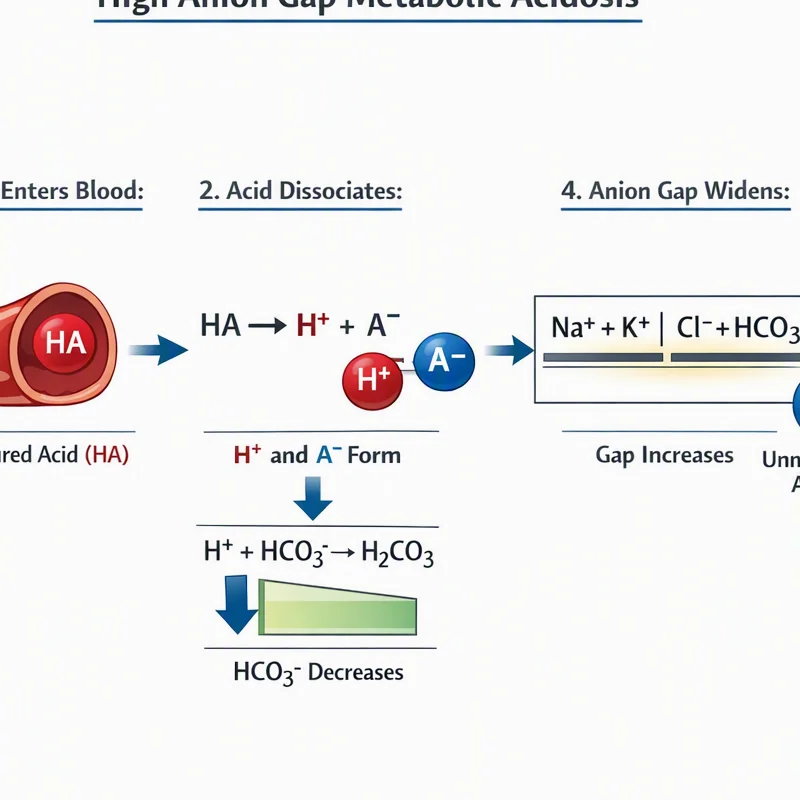
High anion gap metabolic acidosis is often one of the most significant patterns recognized in ICU care. It usually means the body is accumulating acids faster than it can eliminate them, or the kidneys are failing to clear them. The result is a measurable rise in the anion gap and a drop in bicarbonate.
Typical ICU causes include lactic acidosis, renal failure, ketoacidosis, and ingestion of toxic alcohols. Each of these can present with different features, but they all increase the burden of unmeasured acids in the blood.
Lactic acidosis is especially common in hemodynamic instability, sepsis, hypoperfusion, severe hypoxemia, and mitochondrial dysfunction. An elevated lactate often explains the gap, but the clinician should still look for the reason lactate is elevated rather than stopping at the number.
Renal failure contributes by reducing the excretion of acids and organic anions. As kidney function worsens, acid retention becomes more pronounced and the anion gap may rise steadily.
Toxic alcohols such as methanol or ethylene glycol can cause profound high-gap acidosis and require immediate recognition. In these cases, the anion gap may be a critical clue before confirmatory testing is available.
Additional important causes include:
- Acid buildup from ketones from diabetes, starvation, or alcohol use
- Marked tissue hypoperfusion with progressive lactic acidosis
- Medication-related acid accumulation
- Advanced kidney dysfunction with retained acids
Because ICU patients often have overlapping problems, a high gap rarely points to a single diagnosis by itself. It should prompt a focused search for the most likely source of acid production or impaired clearance.
Normal Anion Gap Metabolic Acidosis: What to Consider
Normal anion gap metabolic acidosis is known as hyperchloremic metabolic acidosis. Here, bicarbonate is reduced, but the fall is typically offset by a rise in chloride, so the anion gap remains within the expected range.
The primary mechanism is loss of bicarbonate or retention of chloride rather than accumulation of unmeasured acids. This picture is common in ICU patients after large-volume saline resuscitation, gastrointestinal bicarbonate loss, renal tubular disorders, or certain medication effects.
As chloride rises as bicarbonate falls, the gap may stay normal even though the patient has a meaningful acid-base problem. This is why the differential diagnosis must include processes that produce nongap acidosis, not just high-gap states.
Typical considerations include:
- Diarrhea or other gastrointestinal bicarbonate loss
- Renal tubular acidosis
- Administration of chloride-rich fluids
- Early mixed acid-base disturbances
The differential diagnosis should be guided by potassium level, renal function, urine studies when relevant, medication history, and the patient’s hemodynamic status. A normal gap does not mean the acid-base status is benign; it simply means the mechanism is different.
Delta Gap and Delta-Delta Ratio Interpretation
The delta gap and delta-delta ratio help identify whether a patient with metabolic acidosis has a complex acid-base disorder. These calculations compare the change in the anion gap with the change in bicarbonate to see whether they move in the expected relationship.
This is particularly useful in ICU patients because more than one process often occurs simultaneously. For example, a patient may have high-gap acidosis from lactate and also metabolic alkalosis from vomiting or diuretic use. Another patient may have high-gap acidosis plus a normal-gap acidosis from renal tubular dysfunction or saline administration.
The delta-delta ratio can show whether the fall in measured bicarbonate is proportionate to the rise in the anion gap. If the ratio is not in the expected range, a mixed acid-base disorder is likely.
In practical terms, the interpretation is as follows:
- A compatible ratio suggests a more isolated high-gap process.
- A low ratio may suggest additional normal-gap acidosis.
- A high ratio may suggest a concurrent metabolic alkalosis.
These calculations do not replace the blood gas or the bedside assessment, but they increase diagnostic precision. In critical care, that precision matters because treatment often depends on identifying the full acid-base picture, not only the most obvious abnormality.
When the Anion Gap Can Be Misleading
The anion gap can be misleading when important contributors such as hypoalbuminemia are not accounted for. Since albumin is a major unmeasured anion, low levels can conceal a true increase in unmeasured acids. This is one of the most common reasons an ICU patient with significant acidosis appears to have a normal gap.
Lactate and ketones can also complicate interpretation. A patient may have an elevated lactate but only a mild gap increase if albumin is low or if there is a simultaneous process changing chloride or bicarbonate in the opposite direction. Likewise, a patient with ketoacidosis may have a less dramatic gap than expected if the acid-base picture is mixed.
The result should never be interpreted absent clinical context. Review ventilation, blood flow, kidney function, medication exposure, and the overall course of the patient. A single value is a snapshot; the patient’s condition is a moving target.
Important reasons the gap may be harder to interpret include:
- Hypoalbuminemia reducing the apparent gap
- Concurrent metabolic alkalosis masking acidosis
- Chloride shifts from fluid therapy
- Timing issues between chemistry results and arterial blood gas
In ICU practice, the anion gap is best used within a larger diagnostic framework. It helps with assessment, but the final diagnosis requires integration of the full data set.
FAQ About Anion Gap Calculation in ICU Care
What is an anion gap calculator used for in ICU patients?
An anion gap calculator is used to rapidly assess metabolic acidosis and identify whether unmeasured acids may be present. In ICU patients, it helps guide the differential diagnosis of conditions such as lactic acidosis, renal failure, ketoacidosis, and toxin exposure. It is most helpful when combined with the patient’s clinical context, blood gas, and other laboratory data.
How do you calculate the anion gap from sodium, chloride, and bicarbonate?
The standard formula is sodium − (chloride + bicarbonate). Enter the latest sodium, chloride, and bicarbonate values into the calculator or compute it manually. The result should then be compared with the laboratory’s normal range and interpreted alongside other electrolytes and blood gas findings.
Why should the anion gap be corrected for albumin in critically ill patients?
Albumin is a major unmeasured anion, so low serum albumin can make the anion gap look falsely normal. The albumin-corrected anion gap helps reveal hidden acid accumulation that might otherwise be missed. In critical care, this correction is important because hypoalbuminemia is common and can significantly affect interpretation.
What conditions cause a increased anion gap metabolic acidosis in the ICU?
Typical causes of high anion gap metabolic acidosis in the ICU include lactic acidosis, renal failure, ketone buildup, and ingestion of toxic alcohols. These conditions add to unmeasured anions and lower bicarbonate. The exact cause should be determined by combining the gap with the patient’s history, hemodynamics, arterial blood gas, and broader diagnostic workup.
Can a normal anion gap still occur in a patient with serious metabolic acidosis?
Certainly. A patient can have normal anion gap metabolic acidosis or a mixed disorder in which the gap appears normal despite significant illness. This may happen with bicarbonate loss, chloride retention, or hypoalbuminemia masking a high-gap process. That is why the anion gap should always be interpreted with the full clinical context, not used as the only marker of severity.